
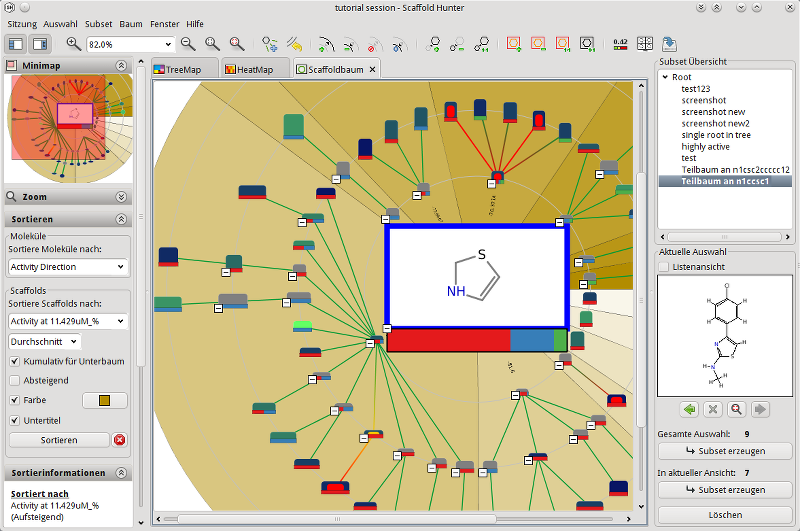
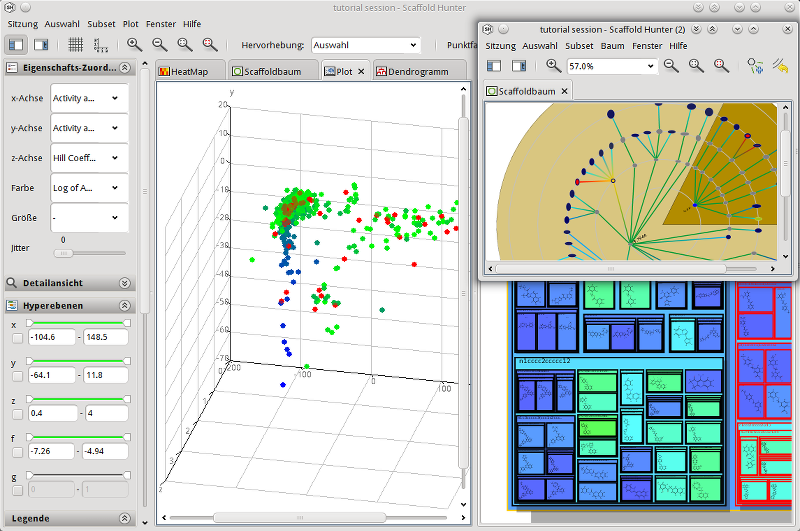
Scaffold Hunter is a Java-based open source tool for the visual analysis of data sets with a focus on data from the life sciences, aiming at an intuitive access to large and complex data sets. The tool offers a variety of views, e.g. graph, dendrogram, and plot view, as well as analysis methods, e.g. for clustering and classification. Scaffold Hunter has its origin in drug discovery, which is still one of the main application areas, and is evolved into a reusable open source platform for a wider range of applications. The tool offers flexible plugin and data integration mechanisms to allow adaption to new fields and data sets, e.g. from medical image retrieval. Scaffold Hunter is used worldwide in research, both academic and commercial, and for teaching at the Technical University of Dortmund, Germany, and the University of Sydney, Australia.
Please visit our Sourceforge project site for further information or follow one of the direct links to specific subpages:
Scaffold Hunter: A comprehensive visual analytics framework for drug discovery
Till Schäfer, Nils Kriege, Lina Humbeck, Karsten Klein, Oliver Koch, Petra Mutzel
Journal of Cheminformatics, 2017, 9:28
(Bibtex)
Visual Analysis of Biological Activity Data with Scaffold Hunter
Karsten Klein, Oliver Koch, Nils Kriege, Petra Mutzel, Till Schäfer
Molecular Informatics, WILEY-VCH Verlag, 2013, 32, 964-975
(Bibtex)
Scaffold Hunter: Facilitating Drug Discovery by Visual Analysis of Chemical Space
Karsten Klein, Nils Kriege, Petra Mutzel
Computer Vision, Imaging and Computer Graphics. Theory and Application,
2013, 359, 176-192 (Bibtex)
Interactive exploration of chemical space with Scaffold Hunter
Stefan Wetzel, Karsten Klein, Steffen Renner, Daniel Rauh, Tudor I. Oprea, Petra Mutzel, Herbert Waldmann
Nature Chemical Biology, 2009, 5, 581-583 (Bibtex)
The Scaffold Hunter project was initiated by Karsten Klein, Petra Mutzel
(both Chair 11: Workgroup Algorithm Engineering,
TU Dortmund at the time of initiation, now
University of Konstanz
and University of Bonn),
and Stefan Wetzel (Chemical Biology,
MPI for Molecular Physiology Dortmund), a first version of Scaffold
Hunter was implemented by the student project group PG504 at TU Dortmund under their supervision.
For version 2.x, many parts of it were improved, extended, and rewritten by the student project group PG552
under the supervision of Carsten Gutwenger, Nils Kriege, and Karsten Klein at TU Dortmund.
We would like to thank the members of PG504, Anke Arndt, Vanessa Bembenek, Ambia Ben Ahmed, Philipp
Büdenbender, Nils Kriege, Adalbert Gorecki, Sergej Rakov, Michael Rex, Gebhard Schrader, Henning Wagner,
André Wiesniewski, and Cengizhan Yücel, and the members of PG552, Bernhard Dick, Thorsten Flügel,
Henning Garus, Michael Hesse, Philipp Kopp, Philipp Lewe, Dominic Sacré, Till Schäfer, and Thomas Schmitz,
for their contribution and enthusiasm in creating the prototype application.
The final reports of PG504 and PG552 can be retrieved here
and here, respectively.
Parts of the software have been developed within the programs
Google Summer of Code 2013 and 2014 by
Jeroen Lappenschaar, Andrey Zhylka and Werner Sturm.
The research assistants Nils Kriege, Till Schäfer, Sven Schrinner and Philipp Mewes have contributed
to the development of Scaffold Hunter in the last years.


